The picture above (currently on sale at Toshidama Gallery), is by the nineteenth century Japanese artist, Toyohara Kunichika. It shows a baffled actor in the role of Gonpachi from a famous darkened scene of the kabuki stage. Gonpachi is reading his arrest warrant. That scene is translated via the upper cartouche to a much less romantic setting with passersby in western clothes and the whole scene lit by a European standard gas lamp. The first gas lamps were erected in Yokohama in 1872 and by 1874 had become commonplace in Edo (Tokyo). Kunichika is being very up to date in this bathetic satire on modern times. The entire series deals with traditional Edoists (residents of Edo, now Tokyo), coming to terms with the rapid modernisation of the Meiji Revolution of the 1860’s.
Sometimes it is easy to adjust to change… sometimes not. In another print from the series (above), the cartouche shows the new Meganebashi bridge in Nagasaki – in rush hour. In a famous kabuki dance, a monk pauses on a stone bridge… (the bridge represents the path to enlightenment and is hard to cross), partly because of a lion which emerges to play with the luxurious peony blossoms. The ease with which the modern crowd passes neatly across the bridge, compared to the existential agonies of the passing, traditional lion dance in the main part of the print, demonstrates the extreme discomfort that some people in Japan felt with the modernisation programme of the Meiji Emperor. There was a real longing for the dignity and the romance of the past and genuine distaste for western ideas which were considered demeaning and base. The Meiji restoration in 1868 was the cause of civil war skirmishes and some unpopularity amongst the Japanese public. Part of the country (principally the merchants) were enthusiastic about the new chances that open trade with the west would bring. Others, who were more traditional, feared the erosion of Japanese identity and were deeply suspicious about modern innovation. This print is a parodic manifestation of that anxiety and distaste.
In Japan, the melodrama of kabuki; the stories of warlords, feudal honour and seedy assignations such as the tragedy illustrated in the print above – which tells the tale of a loyal wife poisoned, disfigured, abandoned and destroyed by a weak, ambitious husband – were seen by most as an embarrassment, a reminder of a less civilised… less technological culture…
Sadahide (1807 – 1873) The Battle of Yashima, mid – 1840’s
In the previous post we had a brief look at the mystification and the unhappiness that rapid technological change had upon the Japanese of the mid-nineteenth century… how their traditional ways were undermined by the sudden influx of gas lamps, trains, telegraphs and so on. We are experiencing a similar change in the form of the digital revolution. The introduction of AI and digital systems has transformed the identity of the individual, created a porosity where in the immediate past there was a sense of nationhood, personhood, personal and inviolable identity. The shift is both subtle… iphones and digital-pay; and dramatic – the state and and big business having unheard of access to every part of an individual’s life.
Kunisada/Toyokuni III (1786-1865) Dashing Roles in New Plays:Nakamura Shikan IV as Goshaku Somegoro, 1860
And so it is for even an established specialist dealership like the Toshidama Gallery. We are falling victim to disintermediation – that is, the easy way in which clients can now access what seems an enticing world of international auctions. One registration with the Saleroom or Live-Auctioneers or any number of their competitors gives you instant bidding access to auctions all over the world, in any currency, however far from home. Several galleries have closed down or been forced to change their business model, which is a shame. A shame because scholarship, conservation, specialist knowledge and the fabric of the collecting world is already starting to disintegrate.
The frustration is more compelling when it turns out that buying at auctions online is becoming less and less worthwhile. Somewhat like the Waterstone’s, the bookseller – driving independent booksellers out of business in the nineteen eighties – the current internet-led disintermediation is taking out long established print dealers and experts many of whom fund valuable research through commercial sales. A recent article in The Daily Telegraph, was titled, How high fees make profiting at auctions virtually impossible. The article goes into some detail about the actual costs of an individual sale or purchase and how the online market is relentlessly driving up costs through buyers’ premiums, typically 26%; plus purchase tax; plus anything up to 4.95% to the online agregator; card transaction fees of 2.5%; and 2.9% for the foreign currency transaction fee. Then there is shipping and packing which even for a woodblock print can be $100.
It doesn’t stop there because the auction houses will then also charge the seller a fee plus any additional ‘hidden charges’. The net result of the compound price gouging is that a print selling at an online auction for £1000 might cost the purchaser, over £1,400. The net cost the buyer must charge to recoup his purchase and pay for his own seller’s fees should he resell at a future date, could hit a combined total of £1600. In other words, the entire market is inflating rapidly and within a short period prints will become completely unaffordable as successive sellers try to recoup costs. The print market will seize as people will be reluctant to take losses on inflated ‘auction’ valuations. This is the opposite of what those firms will tell the customer.
With dealers of repute a crucial service is accurate research. Many auction houses have very little in the way of expert research… it would be unfeasible given the range of stock. As a consequence – and I have seen this countless times – prints are misattributed – usually upwards – and the unwary bidder may inadvertantly purchase a minor artist’s work at an inflated price due to misattribution. As the market-led approach becomes dominant, the supply dwindles, scholarship diminishes, collectors are priced out and reputable dealers close. The market leaders shrug and moves on.
The Sadahide at the top of the page is on sale at £480. It has been pressed to stabilise it, researched, written up and photographed. Its sale price is £480… no hidden costs, no extras, no percentages. Postage and packing is subsidised by our gallery and managed in house. A printed certificate comes with every print. In over a decade of online dealing we have never had a print returned. Toshidama Gallery really does care about the art works, the history and scholarship, about our customers and their satisfaction. If people continue in the belief that online auctions offer a better long term deal then they are mistaken and we and our colleagues will be obliged to come off-line.
Ah well! Pity the poor art dealer. I do think that the passing of so much expertise and exprience is a loss. I hope that it doesn’t come to that.
Toyokuni III (1786-1865) Musha-e of Zhang Fei, 1815
Toshidama Gallery online sells Japanese woodblock prints of superb quality at affordable prices, available to everyone. This is one of the most widely read, popular blogs on Japanese prints on the web. Thank you for your continued support.
Kunisada II, Arashi Rikaku II as Kanamari Daisuke Takanori, 1852.
The print above is one of a series, The Chronicles of the Eight Dog Heroes of the Satomi Clan of Nanso… quite a mouthful! It is a remarkable story that has not directly translated to western tastes and contains a complexity and rhythm which has failed to ignite European or American imaginations. And yet it is a great story, a tale from a genre which is wildly popular in other forms… cast very much in the manner of Avengers Assemble or other Marvel Universe sagas. It is a tale of destiny, revenge, courage, BROTHERHOOD! and the supernatural… what could possibly be unpopular about that?
Kunisada II, The Book of the Eight Dog Heroes: Seki Sanjuro Ill as Komiyama Ittota, 1852.
The genesis of the story makes most people uncomfortable because it begins with the union of a King’s favoured dog and his daughter, the Princess Fuse. This union gives rise to the conception of eight souls, contained within eight glowing orbs… each representing a Confucian value, namely: humanity, justice, courtesy, wisdom, loyalty, sincerity, filial piety and obedience. The conception comes about in the manner of a Grimm Brothers fairy tale, a king offering a reward for an unfeasible act. In this case, the Lord offers his daughter if his dog will rid him of his enemy. The dog, Yatsufusa immediately returns with the severed head of the king’s foe and demands the hand of his daughter. The king cannot refuse and the dog and the princess go into exile. The birth of the eight dog heroes takes place after the selfless act of suicide by the Princes Fuse… she rips open her belly releasing the magical orbs and dies in the arms of her father. The dog meanwhile has been shot by the retainer in the print at the top of the page, Kanamari Daisuke Takanori.
Kunisada II (Toyokuni IV) 1823 – 1880, The Eight Dog Heroes (Hakkenden): Nakamura Utaemon III as Moriguchi Kuro, 1852.
Sixteen years later, the Confucian beads find homes in the wombs of eight human mothers, who give birth to the heroes. The plot follows their growth and leaving home, the development of the characters and the various swashbuckling adventures that lead them to meet and recognise each other as the diaspora of the Satomi clan. The prints in the great Kunisada series pictured on this page are taken from the kabuki production of the Hakkenden and are both portraits of the heroes and some of their attributes, the minor characters of the plot and the actors themselves whose physiognomy would have been instantly recognisable to the theatre going public.
Kunisada II, Eight Dog Heroes (Satomi Hakkenden) Onoe Kikugorô III as Inuzuka, 1852.
The story itself, although it arguably has its roots in traditional folk tales such as the 108 Heroes of the Water-Margin, is primarily the invention of the author, Takizawa Bakin, (1767 – 1848). He worked on the many volumes of the novel for 28 years, releasing illustrated, woodblock printed volumes in regular editions. It was of course wildly popular, the more so when it garnered publicity from the kabuki stage, and then from the woodblock prints like this series that were commissioned to memorialise the perfomances. The plays were shorter, more concise adaptations. Wrongs are righted and the brothers defeat evil and reclaim their family name.
Kunisada II, Eight Dog Heroes (Satomi Hakkenden) Morita Kan’ya XI as Inuzuka Bansaku, 1852.
The stage production of the Hakkenden is famous primarily for the final scene which is one of the most spectacular in the kabuki repertoire. One of the brothers, Inukai Genpachi, has set out to find the last, missing brother and stops at an inn, to find that the innkeepers wife and father have been consumed by a ghostly cat witch, disguised in female, human form. She betrays herself by licking fish oil from a lamp and Inukai Genpachi leaps to assist in the fight. The scene ends with the appearance of a gigantic demonic cat atop the roof of the inn, with the brothers doing battle in scenes of aerial combat above the audience.
Yoshitsuya (1822-1866) Inukai Genpachi fights with the Ghost Cat, from Nansô Satomi Hakkenden, 1852
Of course this fraternal adventure has many faces in different cultures; I’m thinking here of The Three Musketeers by Alexandre Dumas which coincidentally has similar scenes set in French inns and the same episodic structure. All of these tales use cliche and stereotype but somehow we the audience… we the sophisticated audience even, we don’t mind! We are not alone in longing for The Golden Age… it seems as if the mind seeks the reassurance of the mythic past and has done even IN the mythic past! We live with cat-witches and demon dogs, with jolly chevaliers and brothers-in-arms and we need the heroes and the villains and we need art to show us that the Golden Age is really and truly there; behind the curtains.
Engraving from The Three Musketeers by Alexandre Dumas.
The chuban woodblock print above is of an actor in the role of the medieval courtier and diplomat, Sugawara no Michizane. There’s very little to go on when teasing information from it… the cursive script in the cartouche doesn’t tell us much because it is so archaic and unreadable. His robes however are decorated with a motif of stylised plum blossom (the five circles motif) and that is enough to tell us who it is.
The print is modest in size and ambition but it nevertheless shows a quiet fortitude and the more I hold the print and live with it, the more I am moved by the inherent melancholy of the tragic face… so stoic and yet so resigned to a life ahead of loneliness and grief through exile from loved ones. By contrast, the image below, also from the Toshidama Gallery, of an angry, travelling god, (the plum motif transformed into a torn branch and gripped between his teeth) is dynamic, wrathful and vengeful. It is the same character, but transformed by rage into a supernatural being… the Japanese thunder god Kanshoji. I wanted to look at what Michizane/Kanshoji might mean in his two states of being. Is there a lesson in this picture of destructive rage and do mythological inventions help to explain to us how we are and how we might change?
Michizane, also known as Tenjin, and Kanshojo, was born in the ninth century (847-903), deified as a God of calligraphy, and he is often represented riding on a black ox, or clasping to his breast a branch of flowering plum tree. He was the governor of Sanuki, but hated by the Fujiwara clan, and especially by a rival courtier, Tokihira. The two men fell out irreparably over the succession of Emperors, and Tokihira successfully accused Michizane of treason and he was exiled to Chikusen Province. As he started on his exile he cast a last glance to his beloved plum trees in bloom, and composed the following poem:
“When the eastern breeze passes, load her with perfume, O blossoms of my plum trees; even though the master is away, never forget the spring.”
The story would end there, were it not for Michizane’s premature death at age 58. Thereafter the Imperial Palace in Kyoto was ravaged by thunder and relentless lightning and the city experienced weeks of rainstorms and floods. Attributing this to the angry spirit of the exiled Sugawara, the imperial court built a shrine to his memory but even this action did not prevent misfortune befalling the court. He was eventually deified and known as Tenjin, a god of thunder, also known through the literature and the theatre as Kanshoji. He is usually pictured with his beloved plum blossoms, often hurling thunderbolts and dark storm clouds. His various avatars are known throughout the kabuki repertoires, most usually in a play of fanciful invention known as the Village School from the drama Sugawara Denju Tenarai Kagami.
Michizane is a notable example of popular spiritual transformation; often a person of noble birth who is wronged and subsequently transformed into an angry spirit seeking revenge. The contrast here is striking; the image below is a further aspect of Michizane… one that developed as he became ‘pacified’ as it were and transformed once more; this time into the god of learning and scholarship!
From a psychlogical perspective, Sugawara no Michizane contains three aspects: firstly, his conscious aspect, which enabled him to have a career as a successful diplomat. Next is his subconscious aspect; that which raged with an unquenchable flame, setting fire to palaces and flooding whole cities. This aspect, the uncontained subconscious-self literally explodes in his legend. The fire and and destruction that he wrought is in truth the expression of the unregulated self. The final aspect one might call the integrated self. In this aspect we see Michizane as the philosopher. At one with nature and animals, at peace with himself… a scholar, a notable poet, a master of calligraphy and the embodiment of the whole, integrated person. In this final aspect of himself, Michizane has contained, understood and used learning to move on from his horror at the injustice he has suffered and what psychiatrists nowadays might call his ‘maladaptive behaviour’!
Kunisada, Kanshojo, Thunder God
The very simple print at the top of the page here contains many of these suggestions in its gentle, understated portrait of a wronged man. The print will be online and for sale from the 2nd of February at the Toshidama Gallery.
Well, this was meant to be a review of a charming exhibition currently on view at Japan House in London. The exhibition is a beautifully staged display of the history and culture of the little known Ainu people of what is now called Hokkaido in Northern Japan. The cultural position of the Ainu is tricky, and whilst the exhibition is very fine and sensitive to the people of Nibutani (the rural centre that is the real subject of the show), the lasting impression is one of ‘Japanisation’. The respect for the Ainu and most especially for their traditions of oneness with the natural world, at this distance seems something of a shield for the embarrassment at past attitudes. The very roughness and rawness of the natural world inherent in their culture has, like so many well meaning efforts, been lost in the desperation to be modern and clean and relevant. The exhibition at Japan House (which runs until 21st of April 2024), is a kind of makeover of the Ainu and their way of life. There is too much gorgeous photography, too many acrylic tray frames and idyllic tourist landscapes for this to communicate successfully the long struggle of these people.
London, England, Uk, 13 November 2023 – Ainu Stories exhbition at Japan House London.
The picture at the top of the article, apparently unconnected to the “Ainu Stories” exhibition, is a woodblock print by Taiso Yoshitoshi from his late 1880’s series of prints that create a catalogue of monsters and ghosts and superstition of late nineteenth century Japan. The print above derives from the tales of the historical character, Minamoto no Yorimitsu (948 – 1021), also known as Minamoto no Raiko. Raiko is struck down with a mysterious illness whilst tracking a giant demon skull. A priest (sometimes attendant) visits him every night with medicine. One of Yorimitsu’s retainers becomes suspicious and resolves to spend the night in his master’s chamber. He falls asleep night after night, being enchanted by the demon. One night, he digs a sword into his thigh and stays awake, using a mirror to witness the transformation of the priest from human into terrifying, giant arachnid. The following night, Yorimitsu stays awake and attacks the spider, which escapes. His retainers track the creature to a cave where they slaughter it, whereupon thousands of spiderlings flee from its belly.
Yoshitoshi pictures the moment that the demon transforms. We see (to our eyes perhaps), the comical half state of the creature which is both giant spider and yet still wears a ruffled costume from its human form. Raiko reaches for his concealed sword with which he will fatally wound the demon.
As you will see from the Kunichika print above, the story of the demon spider was very popular in nineteenth century Japan. The tale can be found in the story, Tsuchigumo soshi, from the fourteenth century and it is widely held that the Tsuchigumo is a stand-in for the unruly, the disloyal and the rebellious. The term seems in the past to have referred to disloyal clans from the middle ages and most especially refers to tribes such as the Ainu, who refused allegiance to and conquest by the rapidly expanding and militeristic mainland Japanese. There are many people over the years that hold the view that the Tsuchigumo spider is a representation of national anxiety about the near extermination of Ainu culture and what that represents.
From Tsuchigomo soshi, 14th century picture scroll.
The Ainu people as an indigenous and distinctive group have been ruthlessly attacked, betrayed, removed from their land along with their traditional fishing and trading pursuits. .. they have been the victims of a variety of methods of subjugation, which include the vigorous outlawing of their language, beliefs and traditions, right into the late twentieth century. Since 2008, when the National Government of Japan passed a resolution that recognised the Ainu people as racially distinct, things have improved. Even so, that resolution only passed into law eleven years later in 2019.
The connection – partly linguistic – between an indigenous people and the gigantic spider is tenuous and perhaps unhelpful but not unique in its identifying a feared minority group with a shadowy and sometimes supernatural wild beast. In Great Britain, it is the badger which occupies this position. Its old name of brock is one of the few remaining words in the celtic British language, and its existence as a mysterious, underground earth dweller, nocturnal and sabotaging agriculture has made it a stand-in for the indigenous Britons by subsequent settlers, and has for centuries been hunted as vermin. Even now the badger is being needlessly poisoned in a government sponsored campaign of destruction; an attack on that uncomfortable living reminder of our pre-industrial pasts; while the legacy of the Celts has, like that of the Ainu, been made over, to conform to a cleaner, more civilised trope of man-in-nature.
European Badger. Nineteenth century engraving.
We all make our own demons in the end. The spider is a universal candidate for such roles, from West Africa’s Anansi, to the Egyptian goddess Neith and Japan’s Tsuchigumo. Below is a British illustration by the artist Arthur Rackham, of a native fairy tale and nursery rhyme, Little Miss Muffet, whose origins and meaning remain unknown. How strangely similar in feel is this to the Yoshitoshi that we started with and close in date. How alien is the dark character of our superstition.
Little Miss Muffet by Arthur Rackham. Nineteenth Century Illustration
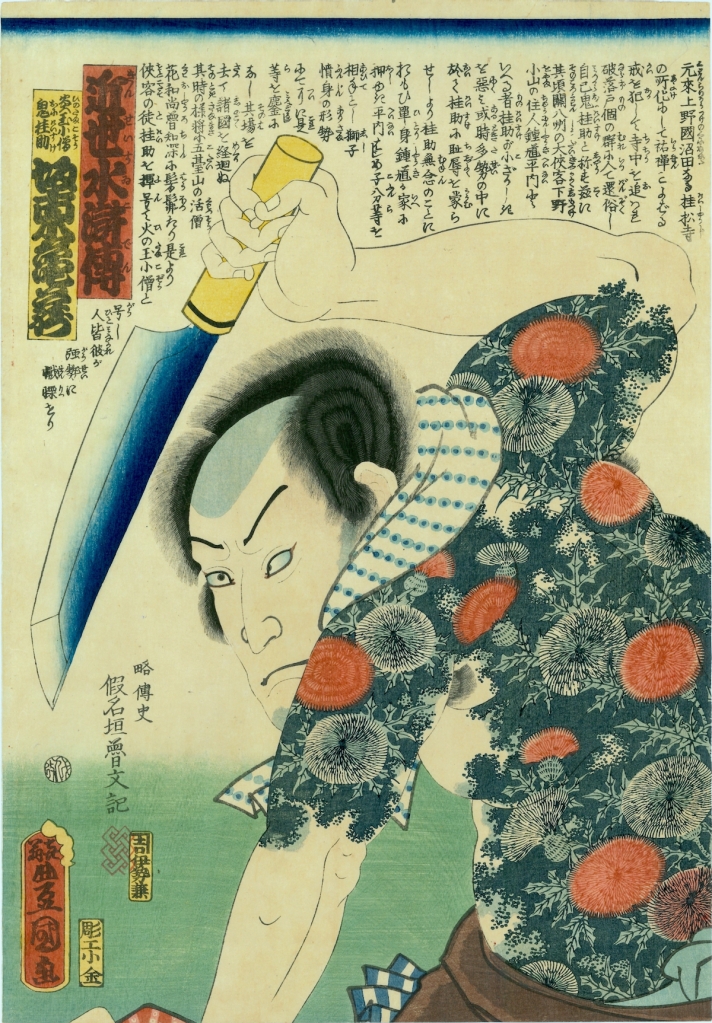
The completely fantastical tattoo subject above is a woodblock print by the Japanese ukiyo-e artist Kunisada from 1862. It is a complex design, and a tremendous and highly original tattoo! The print is part of a small selection of prints at the Toshidama Gallery for December 2023. Among the prints are this Kunisada, a fine print by Kunichika of an actor as an Edo fireman, and a stunning Kunisada of the great kabuki anti-hero Danshichi. (below).
Kunisada, A Mirror of Fashionable Reflections: Danshichi, 1859.
What they all have in common is criminality… Danshichi and the bandit, Hinotama Kozô Oni Keisuke in the top picture were both murderers in real life and their spine chilling crimes were very popular in kabuki dramas. All these pictures are actor pictures… famous stage actors portrayed in these roles. Of course the tattoo nowadays is far from a signifier of criminality and has passed into the fashions and commerce of daily life pretty much anywhere… apart from in Japan! There, tattoos were extremely popular among the rougher townspeople of the late Edo period. Later tattoos were regarded as a barbaric relic of the past and forbidden. This ban lasted until 1948 when tattooing was again legalised.
Kunichika, Flowers of Edo: Onoe Kikugoro V, 1871.
I think that in the west today, the tattoo still carries a slight taboo… the sense of rebellion and certainly the expression of originality and non-conformity in the wearer. We live in a highly conformist and regulated culture. It is depressingly difficult for people to step outside the normal intercourse of daily domestic and working life… ironically in spite of the popular notion that our culture is more tolerant, more accepting of gender, cultural and personal differences. For every encouragement to rebel INTO popular culture and away from societal expectations there is the expectation to conform to a more or less antiseptic and strangulating society where banks, lenders, employers, credit reference agencies, social media and any number of other restraints, drain the living spirit out of us all…
The Surprising Revival of Adolf Loos
…which oddly, leads me away from Japan in the nineteenth century to Germany after the first world war and the career of a strange but influential architect: Adolf Loos. When I was a student in the 1970’s at British art colleges, Loos was an ironic figure to lampoon and deride. He was a modernist, but most famous for his peculiar journalism and often eccentric thoughts on headgear, footwear, furniture and tattoos. In his 1908 essay, Ornament and Crime, he makes the observation that:
Adolf Loos 1870 – 1933
There are prisons in which 80% of the inmates have tattoos. The tattoed people who are not in jail are latent-criminals or degenerate aristocrats.
He goes on to emphasise that good design, cultured living and sensible, ordered utility should be devoid of ornament, which he attributes to inferior taste and a lack of culture and civilisation. The essay contains very offensive observations about non-germanic and ethnic societies as well as using the tattoo as an example of the criminality of the tattooed. Although Loos advocated hygeine, utility, cleanliness and decency in all things, his own life was a pitiful catalogue of unsuitable marriages, sexual obsession and finally, prosecution for possession of hundreds of images of child pornography and sexual exploitation of minors. Had he lived, he would undoubtedly have been an enthusiastic Nazi to boot! I was therefore surprised to see that Penguin Random House had repinted Loos’ complete works including Ornament & Crime, as recently as 2019.
Kunisada, Actors with Poem Slips
I have written on this blog about the development of the tattoo in Japan, its association with heroes and bandits and its popularisation in the 1820’s through Kuniyoshi’s fabulous series of prints, 108 Heroes of the Suikoden. The mainly passive but vast population of townspeople had an uneasy fascination with anti-heroes… much like western cultures today in some ways. There was a particular type of Edo street fighter or gangster called an otokodate, it was imagined that these men were romantic figures who, like the firemen of Edo looked after the poor and downtrodden by opposing the ruling samurai class. These gangs gave way eventually to the organised crime gangs of modern day Tokyo, the Yakuza. The truth was less romantic. The street gangs of Edo were nasty and tough and life around them was highly unpleasant, and yet the full body or the sleeve tattoo that they favoured has persisted outside their culture in defiance firstly of legal prohibition, then of widespread condemnation through commentators such as Adolf Loos, until we arrive today at a place where the extraordinary imagery of ukiyo-e woodblock prints has found its way into the high streets and tattoo shops of every town in England and surely over Europe and America.
Tattoos today continue to represent individuality, personal romantic or cultural preference and to some extent as raised here earlier, a rebellion… beneath the shirt cuffs, against a harsh and authoritarian world.
Kunisada, Nakamura Fukusuke I in the Dance Sequence: Funa Torite Megumi no Ôtsu-e, 1857
What a joyous and splendid image this Kunisada print is. An artist… (perhaps a portrait of Kunisada himself?) leans back in astonishment, one hand holding a Japanese brush and clutching his brow, the other gripping the table for support. Before him a parade of fantastical creatures, an apparition of mythologies seeming to leap as if in a dream from the blank sheet in front of their creator. Meanwhile, a similar cast of characters cover half a dozen completed, discarded sheets on the floor… what is going on?
Kunisada, Portrait of Iwasa Matebei.
The print is derived from a dance work, itself derived from a puppet theatre play, that was in itself derived from a folk tale of an ethnic art form depicting gods and myths and sold as crude sheets of paintings to the early tourists of the Tokaido Road. As the movement of people became easier and more tolerated in eighteenth century Japan, a notion of tourism became established, such that Edo citizens might bring back souvenirs when they travelled; and these portable pictures, with their exotic themes and crude execution, became very popular among townsfolk. The paintings utilised traditional folk themes of demons, deities and heroes in a variety of often comical or satirical poses. By the nineteenth century the troupe were reduced to nine or ten comical vignettes, many of which were made famous through kabuki dramas. In this print we see, reading from left to right: Yarimochi yakko a samurai spear bearer who was a symbol of safety on a journey.
17th Century Otsu-e of Yarimochi Yakko
Above we see a seventeenth century original clay painting of the character. Kunisada proceeds to use the other commonest symbols of the Otsu repertoire… . Next is the enigmatic monkey carrying a gourd, riding an angry catfish, also pictured below. Popular mythology stated that the earthquakes that plagued Edo were caused by a gigantic and restless catfish who could only be stilled by the application a gigantic gourd. This was perhaps an illustration of a zen koan. Catching a slippery catfish with an unsuitable utensil such as a smooth and rounded gourd would be so difficult as to be almost impossible, thus illustrating the impossibility of using rational explanation to expalin zen principles through logic. Perhaps it was merely ackowledgedging a Chinese tradition of animals of gigantic size being associated with geological features… the turtle that carries the world on its back for example.
The foreground scene features a familiar pairing of the god Fukurokuju, one of the seven lucky gods in Japanese mythology. Fukurokuju is usually portrayed with an exaggerated cranium as here and to add to the humour of the scene, Kunisada has included a second of the lucky gods, Daikoku, who is sharpening a razor on a whetstone in preparation for shaving Fukurokuju’s head by use of the tall ladder behind him.
17th century Otsu-e of Fukurokuju and Daikoku
Watching is the beautiful Wisteria Maiden, the star of a famous quick-change classical dance in the kabuki theatre. All of these characters appear as if from a mysterious cloud generated from the artist’s brush. One further character, outside both the dream-like apparition and the artist’s studio, is the boatman Sendo, whose prow appears in front of a brightly painted kabuki stage curtain.
But what of the artist, and what has he done? He sits in the right-hand foreground surrounded by the tools of his trade; the shelves of ground pigment, paper, weights, ink-stone, water dipper and so on. The artist is a depiction of the legendary painter Ukiyo Matahei, loosely based on Iwasa Matabei (1578-1650), who was supposed to be the founder of the ukiyo-e school and the inventor of ôtsu-e. Various legends tell of the characters in Matabei’s paintings coming alive and these were sometimes depicted in paintings and prints, including a triptych by ukiyo-e artist, Kuniyoshi published in 1848.
Kuniyoshi, Popular Ôtsu-e Paintings for the Times, 1848.
This is the only known self-portrait of Kuniyoshi, and the irony is that he is portraying himself as Iwasa Matabei. Kunisada mimics both the diptych and a triptych of 1848, but this print of 1857 commemorates a dance performance of that year featuring the fantastical skills of the actor Nakamura Fukusuke, whose likeness the artist’s is. The dance sequence acted as an interval in the lengthy performance of the popular revenge drama, the Chushingura. The dance is based on a traditional play for the puppet theatre in which Matahei is about to be arrested on false charges when suddenly his painted characters spring to life to defend him. In fact the actor Nakamura went on to play all the parts in the performance and the event was celebrated by Kunisada not only in this triptych but also a series of single sheet prints from 1957, depicting the Wisteria Maiden and the Catfish in one print; also the boatman Sendo and the standard bearer in another.
Kunisada, Fukusuke I as the Wisteria Girl and a Monkey with Catfish and Gourd
Cards from the DIMITRI & WENLOP Limited Edition Tarot Set, 2023
In the summer of 2023, Toshidama Gallery Director, Alex Faulkner and artist Christopher Bucklow revived their fictional personae, Dimitri & Wenlop, for an exhibition of recent paintings at Antitaupe Gallery in Bruton, Somerset. The title of the exhibition was, The Alphabet of Dimitri & Wenlop… referring in part to the production of a limited edition set of cards, based on a traditional Tarot pack. The images on these cards were all derived from details of the paintings in the exhibition itself. The titles and the graphic design were suggested by the cards in a conventional Tarot pack. Both artists contributed thirteen cards each, making a total of 26 cards per pack. The first printing was limited to 30 sets, the second impression to 100 sets. Each set is hand signed and numbered by the artists.
Cards from The Alphabet of Dimitri & Wenlop, Limited Edition Boxed Set of 26 Cards, 2023
The sets are mysterious… beautifully produced and arcane in feel, they invite speculation as to their use, function and meanings. They are not cards of divination in the usual sense but are nevertheless divinatory, by design and presence. The images derive from Ukiyo-e, Renaissance paintings, American Abstract Expressionism, Alchemy and Mysticism. The uses might of course be purely decorative but they work also as a series of Jungian suggestions… THE VOYAGE OUT for example evokes Jung’s Night-Sea-Journey… what does that mean to the card-player? What of the HANGED MAN who in this incarnation is shown as the FLAYED MAN? The cards when used in this way for traditional ‘lays’ disregard the common interpretation, taking the user instead into their own psyche by dint of suggestion, by dint of shared myth.
The Mysteries of Unsun Karuta
Some Cards from a Pack of Unsen Karuta
The picture above is a selection from a Japanese card game called Unsen Karuta. Modern playing cards were introduced to Japan by Portugese traders in the 16th century. The practice – which encouraged gambling – was banned, but inventive Japanese manufacturers created a similar game that appeared to be wholly native. The complete Unsen Karuta pack has 5 suits of 15 cards: Cups, Swords, Coins, Batons and Drums. Each suit has six court cards: Un (a god of good luck or, in one instance, Daruma, a Zen Buddhist); Sum (an enthroned Chinese official); Sota (a maid); Robai (a dragon which has been transferred from the Portuguese aces to the Japanese court); Kiri or Koshi (King or other enthroned person), and Uma (Cavalier or simply a horse). There are also numerals, 9-1, the aces being represented simply by a single suit symbol without a dragon. The rules are arcane and complicated but the similarity with the Tarot pack is immediately obvious.
Unsen Playing Cards from the 17th Century
The Chinese most probably invented playing cards as a woodblock-printed extension to traditional domino games. From there, the idea of the cards travelled to Persia, where they became standardised, rectangular cards with suits of cups, coins, swords and so on. These cards were brought to Europe in the 14th century, and once again printed using woodblocks. Luxurious tarot card packs developed there in the 15th century, first as gaming cards and latterly as a mysterious means of fortune telling. Tarot’s origins were linked to ancient Egypt and the Far East and these cards were exported back there, transforming themselves, (as we have seen) to the game of Unsen Karuta. As a ukiyo-e dealer and an artist, I like this circularity… and the Dimitri & Wenlop pack deliberately plays upon that as a means of linking the disparate cultures mentioned above, across time and space.
The Tarot of Dimitri & Wenlop, 2023
The Tarot of Dimitri & Wenlop
The Dimitri & Wenlop cards are a beautiful set of small limited edition art prints. They nevertheless have the possibility of making ‘lays’, these lays being more suggestive of internal divination than external mysticism. At one level they are a gateway to the creative process. Christopher Bucklow writes in the introduction to the lavish catalogue that accompanied the show:
A pack of tarot cards. In the deck the characters of the major and minor arcana sit waiting in the wings, like actors about to go on stage. A card is drawn and a character treads the boards. More cards are drawn until finally the lay is complete. The cast is now assembled and the process of trying to fathom the plot begins.
A blank canvas. You begin on a whim without forethought. Perhaps a character that you have painted before wants to come back ‘onstage’ from out of the wings. Or perhaps it is someone you have never painted, someone who has been waiting in the darkness of the deck. From imagination you paint their image…then, as if it were a séance, another figure wants to join them; you paint this figure too. These actors are improvisational specialists. They interact without inhibition. Gradually you start to receive their story. Objects may appear around them, and their context too; a landscape, or a city, or maybe a room. Now the process of trying to understand what has appeared at last begins.
Christopher Bucklow, The Moon’s Inner Vision, 2016. Oil on Canvas. 213cm x 510cm
Tarot cards can also provide a gateway from the prison of materiality. Alex Faulkner writes, in the catalogue introduction:
Cards of divination are perhaps no more than prompts… reminders of an inner vision ALREADY in the consciousness of every person. Everyone carries within themselves their own deck of cards, their own breadcrumb trail to a greater consciousness that lies beyond the mesmerising curtain of rationalism, beyond the crushing wheel to which we are all tied. What defence can we build against senseless consumerism, against aggressive late capitalism, against materialism, against sentimentality, against the blandishments of self-interest? Where can the individual take refuge from the GLAMOUR? In the mind — of course. There we can ALL be rulers of our own limitless FIELD! The mind is the last refuge… not YET fully exploited nor yet commodified by machine logic; the mind… the conscious door to the sub-conscious eternal, the mind is the first and the last resort.
Alex Faulkner, Age of Iron, 2021. Paint on wood. 23cm x 41cm including frame.
Utagawa Toyokuni I (1769-1825) Actors in the Drama Onna Hachinoki, 1810’s. Oban Diptych.
The online market for Japanese prints is changing and the Toshidama Gallery is looking to trade more in the real than in the digital world, a platform we have innovated in for the past ten years or more. The online gallery will remain but will feature fewer, specialist prints. This blog will continue and will expand to cover other areas of the arts and culture.
Toyohara Kunichika (1835-1900). Minohara’s Death at Kichi Pass, 1898. Oban triptych.
To mark this change, the gallery is having a tremendous 50% SALE of EVERYTHING on the website. There are some outstanding prints and some very good bargains to be had. Japanese woodblock prints – as anyone familiar with this blog will know – are one of the greatest influences on twentieth century western culture in the fields of the visual arts; in design, architecture and painting. It should be… it is, a privilege to own one of these great works. The fact that every one of the prints we sell can be found in a museum collection somewhere in the world and, uniquely, is still available to own at such affordable prices, makes their attraction all the greater.
Utagawa Kuniyoshi (1797-1861) Ichikawa Danjuro VIII as Narukami Shonin, 1851. Oban.
The highlight of the sale is probably the Kuniyoshi print of Ichikawa Danjuro VIII as Narukami Shonin, from 1851. But, there are many prints on the site at hugely discounted prices. I sincerely hope that you find something there that you would like to purchase. The Toshidama Gallery looks forward to future shows of specialist prints, so do please join our mailing list for updates and offers.
Toyokuni III (1786-1865) Actors at the Fifty-three Stations of the Tokaido Road
The Toshidama Gallery is currently showing an important collection of five vertical diptychs by the artist Katsukawa Shunsen (1762-1830). All five in the set were once mounted on hanging scrolls that were considerably longer than the double oban print.
The scroll form – kakejiku – originated in China nearly 2,000 years ago. Exported by Buddhist missionaries, the scrolls were useful teaching aids for disseminating religious and aesthetic ideals, being both beautiful and impressive; they could nevertheless be easily rolled into portable tubes. The form became popular in the Heian Period, (794 – 1192) and the subject matter and usage began to include secular and specifically Japanese themes.
Detail of 17th-century hanging scroll showing scroll making.
Initially reserved just for the samurai class, the richly decorated scrolls tended to be hung in specifically dedicated rooms in large houses. These rooms were called tokonoma and they were spaces that connected art with day to day life… a precursor perhaps to western attitudes to gallery spaces in country houses. During the middle ages (1185 – 1603), the rules and customs around the use of the hanging scrolls developed and a strict code of decoration, content fields and so on was developed side by side with other formal practices such as the tea ceremony.
Katsukawa Shunsen, Woman in Chrysanthemum Kimono, 1810’s
The customary format for the scroll was vertical, anything up to 3 metres in length. The centre panel was traditionally a piece of calligraphy or brush painting; after the 18th century this came to be replaced by (mass-produced) woodblock prints. There was a highly decorative silk brocade margin to the print called the nakamawashi and a wide but plainer margin top and bottom. Contrasting narrow horizontal bands between the two were called the ichimonji. The top of the scroll was suspended from a narrow bar and the bottom was attached to a cylindrical roller made from bone or ivory, though later in the Meiji period this was merely wood or bamboo with decorative ends to give the impression of richness — a long way from the Buddhist ideals of the Chinese missionaries. Further still away from its spiritual beginnings was the change in subject matter which over the centuries came to represent beautiful women – more often than not, fashionable prostitutes – in place of aesthetic mountain tops, clouds and waterfalls.
A selection of scrolls showing traditional boxes and scroll ends.
Inevitably the vulgarised versions of the original medieval form were designed to signify wealth and sophistication in the middle class houses and brothels where, in the nineteenth century, they came to hang.
The current selection of prints at the Toshidama Gallery are most likely to have been produced between 1805 and 1820. All of the prints are of females: courtesans, geisha, escorts — there are many words to describe young women of high status who were professional mistresses. The position was dangerous and tenuous, but the social structure of Edo Japan was very different to modern society and for those in the west, of course the particular moral structure of a loosely Christian society was wholly absent. When the American navy imposed trade agreements on the failing Tokugawa regime in the mid 1860’s, the pious missionaries and capitalist trades representatives demanded a moral revolution designed to clean up public displays of immorality, mixed bathing, public nudity and of course the vast and, to them, incomprehensible “red light district”, the Yoshiwara. During the early nineteenth century, women such as those pictured in these prints were admired and celebrated, although attitudes changed dramatically after the Meiji revolution. It is images such as these that contributed to the American and European idea of the exotic, sexually available Japanese female characterised in Puccini’s Madame Butterfly, after woodblock prints and scrolls were exported to cities like Paris, Chicago and New York.
Woman with elaborate wooden hair pegs – kanzashi.
All of the women depicted in these prints were escorts of one sort or another in the city of Edo (modern day Tokyo). The name Oiran was given to successful courtesans in the nineteenth century… some were so powerful that they were given the title, “Castle-Topplers”… an indication of the wealth that they could command. As these scrolls clearly show, attitudes to this occupation were very different to attitudes today. Oiran were hugely influential in fashion, dress and manners; in the print below, note the extraordinary and elaborate wooden hair pegs called kanzashi— ten in all, each of them at least a foot in length. These were often made from tortoiseshell, silver, gold and gemstones, worn in a number of heavily-waxed hairstyles. Such decorations were highly symbolic of the successful and desirable status of the woman. It remains popular these days to make distinctions between oiran and geisha. Geisha were theoretically entertainers, sophisticated stand-ins for upper class wives… oiran were exploited, indentured prostitutes. As in this image, oiran would imitate geisha but in a gaudier way, with larger hair, more ornate kimonos and a more alluring gait. Oiran were decadent and showy.
Katsukawa Shunsen, Woman with Carp, 1810’s
The prints themselves have been removed from their scroll backings, although thin traces of the decorative papers are just visible at the tops and bottoms of each sheet.
All of the prints in the collection are in very good condition. Kakemono-e are often badly discoloured or damaged because of exposure to cigarette smoke and the fumes from oil lamps. These scrolls were presumably kept in the traditional scroll boxes called, kiribako prior to their separation from the backing and safer keeping in folders.
Shunsen is a highly regarded artist and very collectible. These prints are excellent examples of his mature style and rare survivors of a somewhat forgotten genre.




 Toshidama Japanese Prints